

Why Am I Such A Fan Of Adding Rather Than Subtracting When I Start Working With A Nutrition Client?
- a-crewandy
- Apr 23, 2025
- 3 min read
Why Am I Such A Fan Of Adding Rather Than Subtracting When I Start Working With A Nutrition Client
I want to pre-face this blog post by saying the following. I want my brand to be associated with sustainable change, helping people not just achieve their goals but setting them up for life long success. That means I don't ask people to jump onto crash diets or live in a calorie deficit so large that they are potentially doing themselves more long term harm than they are long term good.
Back to the question:
Why Am I Such A Fan Of Adding Rather Than Subtracting When I Start Working With A Nutrition Client?
To put it simply, change is hard both psychologically and physically. So when it comes to changing habits of a lifetime it takes time, will power and the right plan to get you there. The unfortunate reality is, a lot of diets designed for weight loss fail because they are unenjoyable or over challenging.
Now clearly everyone is different, meaning strategies will differ depending on the person, but thinking about that psychological impact of change, I believe that for a majority of people, thinking about what they can add, rather than take away, in the first instance, is a great way of getting started. Here are some great examples:
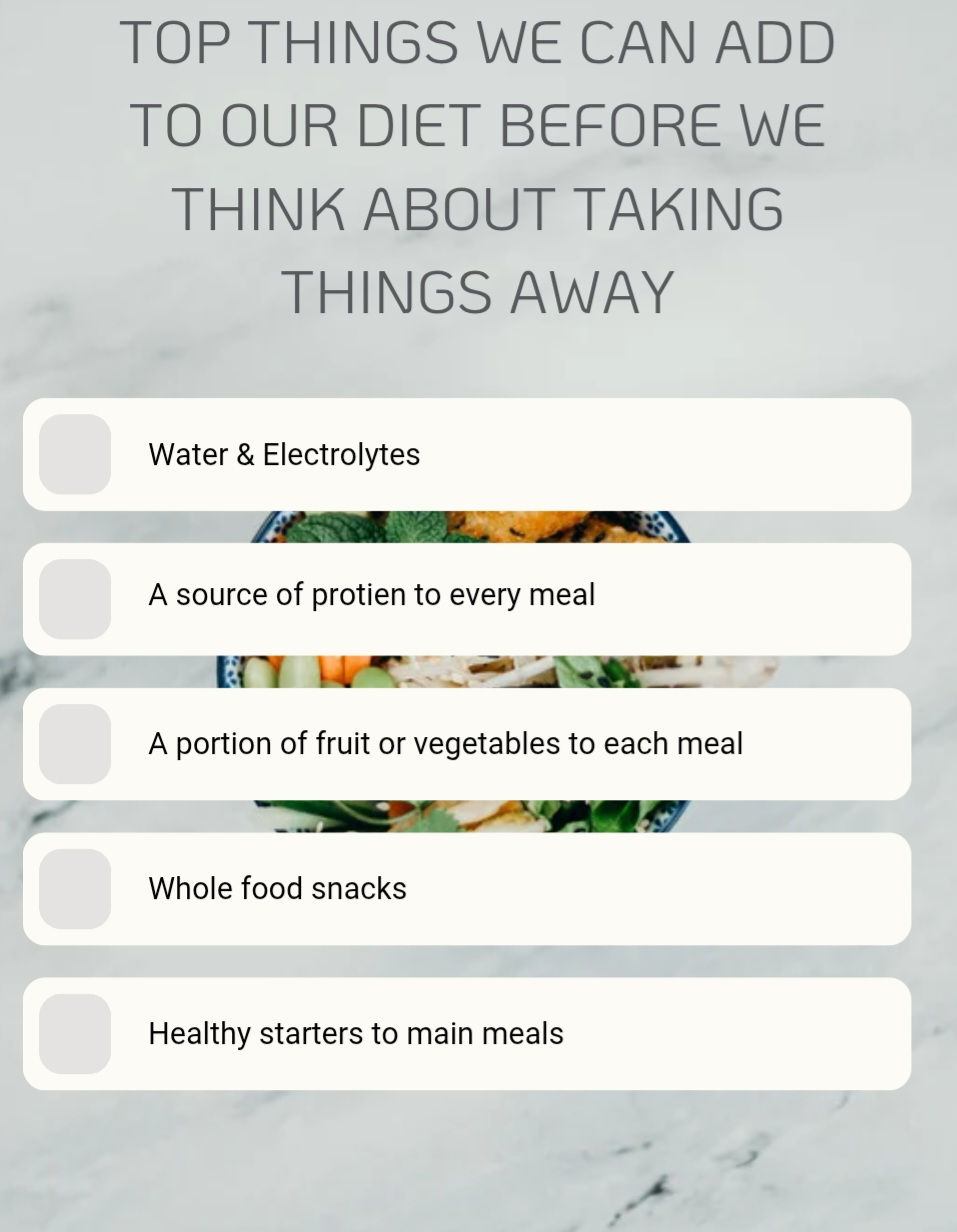
Can we add water and/ or electrolytes
Let's be honest, the majority of us don't drink enough water and many who do don't get the full benefit as they are not replacing the other micronutrients lost through sweat that allow us to absorb that water effectively. Not only should we be more hydrated but if we can add water in strategically, for example, in the half an hour leading up to a meal, we can create that feeling of being fuller which can help with portion control (for someone trying to lose weight that is). This is often the first and most simple step that would ask people to do right from day one.
Can we add a protein source to every meal
Typically people tend to over eat carbohydrates with limited protein sources. Asking people to add one protein source per meal is a great way to feel fuller for longer and start to balance out the macro ratio's that a person is eating. This is a great early step to get people thinking about at the start of their journey.
Can we add portions of fruit and/or vegetables to your day
Much like protein sources people tend to under eat whole fruit and vegetables. Whilst yes juiced versions at least get the nutrients into your body the reduced fibre causes an increased blood sugar and therefore insulin spike in the body. Planning meals which have a source of fruit of vegetables in them is another great step.
Once we have looked at things we can add I would typically look to see at what replacements we may be able to implement (whilst making sure not to replace everything). For example could we replace the 10 O'clock trip to the biscuit barrel with a trip to the fruit basket? Could we replace sugar in cups of tea with a sweetener, depending on your goal.
And then finally taking away, the aim being that by this point, naturally, someone has taken away some of what they used to eat because we have added in other things. For example their Carb to protein ratio may have already started to balance out because we have added a protein source to each meal. It is also possible that by drinking water 30 minutes before each meal, combined with the added protein, will have already helped moderate portion sizes because you are feeling fuller and fuller for longer. Once we have established some positive habits looking at what we might take away is generally an easier sell. In my mind anyway, starting with the positives of how we can add rather than take away, improves the psychology around dieting.
It's a hard culture to change but what it’s a strategy I like to try to implement (even if I do acknowledge that this isn't always the right thing for everyone).
If you have any nutrition questions please feel free to reach out.
Andy


Comments